Rural Health Initiatives

SDAHO Rural Health Initiatives is committed to enhancing rural healthcare through strategic partnerships, contracts and grant funding. This goal is supported by the SDAHO Healthcare Research Education and Trust, a 501(c)(3) organization that enables SDAHO to pursue funding opportunities from federal, state and private foundations. By leveraging these resources, we empower our members to implement innovative solutions, increase healthcare access, and improve health outcomes, ultimately advancing healthier communities across South Dakota. If you have questions or need assistance, please contact any member of the Rural Health Initiatives team listed below.

MBQIP/FLEX

Purpose of MBQIP: MBQIP is a quality improvement activity under the Federal Office of Rural Health Policy’s (FORHP) Medicare Rural Hospital Flexibility (Flex) grant program. Launched in 2011, the goal of MBQIP is to improve the quality of care provided in critical access hospitals (CAHs) by increasing quality data reporting by CAHs and then driving quality improvement activities based on the data. MBQIP provides an opportunity for individual hospitals to look at their data, compare their results against other CAHs, and partner with other hospitals around quality improvement initiatives to improve outcomes and provide the highest quality care to every patient. MBQIP/Flex program is brought to you by the SD Office of Rural Health. The SD Flex Coordinator is Michelle Hoffman. If you have questions on how this program is administered, please contact Michelle at: Michelle.Hoffman@state.sd.us

Did you know?

Did you know that by participating in the MBQIP/Flex program, SD hospitals have received benefits such as:

  • CPHQ exam preparation
  • Access to Antibiotic Stewardship education,
  • Trauma webinar series through SD Trauma program,
  • Emergency Nurse Pediatric course
  • Revenue cycle trainings,
  • Charge master reporting tool
  • Billing and coding education
  • Individual hospital performance improvement projects
  • Various Quality speakers

Without your participation in MBQIP/FLEX, these programs and benefits would not be available.

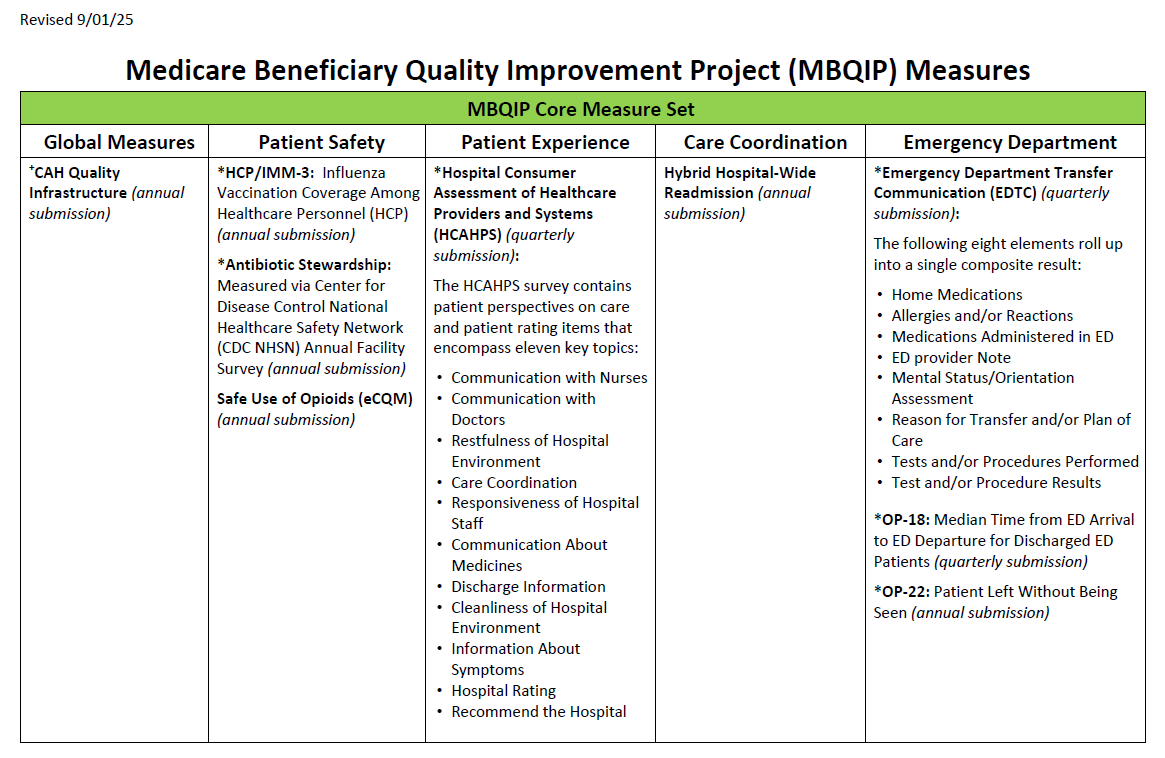
This table lists the core MBQIP Measure for South Dakota. There are 5 domains: Global Measures, Patient Safety, Patient Experience, Care Coordination, Emergency Department.


Below is information that will help to answer questions you may have or provide you with additional resources. If you are not finding the information you are looking for, please contact the SDAHO Quality Team by emailing Michelle Jury at Michelle.Jury@sdaho.org.

This data is entered yearly into a link sent by the MBQIP program
  • This information gets submitted to the federal government quarterly through a link sent directly to you through email by Michelle Hoffman, SD State Flex Coordinator.
  • EDTC resources and FAQs
  • This data is collected yearly and entered into HARP - click here
  • To check if your OP-22 data has been received by CMS, please click here and type in your hospital 6-digit CCN number. Click enter and you will see information stating Yes/No about your OP-22 data. Please note the dates the page was last updated to ensure you did not submit after that timeframe.
  • Resources
HCP/IMM-3 (formerly OP-27):
Antibiotic Stewardship:
  • How to set up a new account in HARP: Both steps need to be done to be able to enter data into HARP
    • Step 1: Click here and follow video instructions on HARP Registration Training Video
    • Step 2: Click here and follow the instructions under “To Register as a Basic User or Security Administrator/Official in the new Hospital Quality Reporting (HQR) System. We recommend asking for Security Administrator/Office.
  • When you register, you will have 2 different webpages to use for HARP. Your same username and password can be used on both pages; however, your HARP data gets uploaded to the Hospital Reporting Page (#2 below)
    1. HCQIS Access Roles and Profile page = HARP Access Roles and Profile link
    2. CMS.gov: Hospital Quality Reporting page = HARP Hospital Quality Reporting link
The Future of MBQIP: Are You Ready? | Courtnay Ryan, Telligen | PresentationVideo

A Dive Into Emergency Department Transfer Communication (EDTC) | Courtnay Ryan, Telligen | Presentation | Video

Using your MBQIP Data Data Report to Inform Your Quality Improvement Project | Courtnay Ryan, Telligen | PresentationVideo

Psychological SafetyMolly Mackey, LEAderRNship Institute | Presentation

Surveyor PreparednessJean Koch, SD Dept of Health | Presentation


HQIC

HQIC stands for Hospital Quality Improvement Contractor. SDAHO is contracted with Iowa Health Collaborative (IHC) to support hospital efforts to increase patient safety and improve quality of care. This is the fourth Centers for Medicare and Medicaid (CMS) led hospital quality improvement program since 2012. It is a national initiative which began in 2020, continues through 2024, and is designed to support critical access hospitals, and hospitals that are low performing and serve vulnerable populations. IHC and partner organizations collectively known as the Compass Network includes SDAHO, Kansas Healthcare Collaborative, and Mississippi Hospital Association. IHC’s mission is to facilitate exceptional healthcare quality, safety, and value in the nation. HQIC guiding themes are:  Patient Centered, High Reliability and Culture of Safety, Strategic Partnerships and Collaboration, and Partnering Beyond the Quality Team. The data collected for this project is entered into the Compass Data Portal and NHSN. We highly encourage entering data monthly, the data is due 45 days after the month end.

Did you know? 

Did you know that participating in the HQIC program provides benefits such as:

  • Responding to emerging patient safety issues via an agile and responsive approach
  • Evaluating population-based data that is specific to the facility or area of the country
  • Access to patient level data for quality improvement efforts
  • Education and networking opportunities
  • Participating in a program specifically designed for Critical Access Hospitals
  • Facilitating healthcare transformation through identification, use and spread of evidence-based practice
  • Access to quality improvement guidance via state-specific quality consultant
  • Ongoing action to adapt and test practices in support of achieving the following goals:
    • Goal 1: Improve Behavioral Health Outcomes with a focus on decreased opioid misuse
    • Goal 2: Increase Patient Safety with a focus on reduction of harm
    • Goal 3: Increase the Quality-of-Care Transitions with a focus on high utilizers in an effort to improve overall utilization

Below is information that will help to answer questions you may have or provide you with additional resources. If you are not finding the information you are looking for, please contact the SDAHO Quality Team by emailing Loretta.Bryan@sdaho.org or Michelle.Hofer@sdaho.org

  • Orientation guide
    • This orientation guide is very important to any new quality improvement professional. It is the first step in learning about the Compass HQIC, including its measures, resources and much more.  Please read through it carefully and follow any instructions.
    • Compass HQIC Network Overview
  • Getting started: Compass Checklist
    • Follow the 3 steps on this form to get connected, registered for Compass education, and get access to the Compass Portal. We encourage you do the 3 steps as soon as possible when first starting the HQIC program.
Compass HQIC self-reported data is due into the portal 45 days from the month end. For example: January data would be due March 15th.
  • Compass HQIC Measure Set
    • This measure set serves as a guide for the states within our HQIC network (including SD) on each individual measure.
  • Review the key closely at the top of the measure set to better understand the data sources. Some measures are required, and some are optional. Please note data sources include:
    1. Self-reported (Compass portal)
    2. Administrative claims
    3. NHSN
  • Specific resources under each measure set section are listed in the next tab called “Measure Set Resources”.
  • Central Line Associated Blood Stream Infections (CLABSI)
    • This is reported in the NHSN portal monthly
    • FAQs: Bloodstream Infection (BSI) Events this site has a great amount of information about CLABSI.
    • If you would like to email NHSN to verify a CLABSI- use the FAQ link above and scroll to number Q31. It will tell you exactly how to email them and what template to use.
    • NHSN Healthcare‐associated Infection (HAI) and Present on Admission Infection (POA) Worksheet Generator - This calculator on the NHSN website provides a working document to help guide hospitals in identifying Healthcare-associated infections.   It helps identify the 7-day window period, date of event, present on arrival, Healthcare-associated infection determination, 14 days repeat infection, and secondary bloodstream infection attribution period
  • Health Equity Organizational Assessment (HEOA)
    • These questions are on the Compass portal and are answered bi-annually.
    • A three-part course on HEOA – This course is very helpful going through each question on the HEOA assessment.
  • Patient and Family Engagement (PFE)
  • iCompass Academy eLearning this website has multiple educational opportunities. It is free and we recommend all Compass users register for this website.
 
  • REAL Readmission Report Guide
  • Health Equity Pledge
    • Health Equity Roadmap - This document explains the Health Equity Pledge and gives an excellent roadmap on health equity.
  • SMARTIE Goals
    • SMARTIE goals require us to think of inclusion and equity in setting goals that will
      lead to better outcomes and the change we are all working toward